The brain drain problem Mongolia faces is more evident now than ever, as overseas Mongolian online communities sprout and more Mongolians are active online, whose locations are mostly outside of Mongolia. I don't know what the latest government figures are, but last I heard, the estimate was somewhere in the range of 100,000 with some suggesting an even higher figure of 200,000. At this rate, Mongolia will turn into a country heavily reliant on remittance, like India, Mexico and the Philippines. Remittance may be a quick fix to financial problems at home, but hardly a long-term contribution to the economy and the infrastructure. According to the World Bank Migration and Remittances Factbook 2008, in 2006 inward remittance to Mongolia of USD182million made up 6.7% of the total GDP, while outward remittance was 2.9%. In 2007, the inward figure rose to USD197million.
PM Bayar's government is realizing the strains of outward talent flow. The Prime Minister's written an open letter to all overseas Mongolians, distributed to the online Mongolian communities around the world, expressing his admiration for their courage and perseverance and finally reminding them that their country needs them now more than ever. A well-written and at times almost poetic letter lists out achievements the Mongolians should be proud of starting with the ancient Pax Mongolica to the recent Olympic and Paralympic successes.
On the other hand, as the Mongolian economy stabilizes and enters a growth period due to the mining and real estate industry booms, more and more young Mongolians are returning home. What are the immediate stopgap measures the government can take to stop this brain drain? Are they doing anything? So far, very little as far as I can see.
I don't know if the UNDP or the Mongolian government have published figures on the number of talented / tertiary-educated Mongolians migrating abroad, I haven't really been able to find any so far. What may complicate the talented migration figures is the large number of high-school graduates leaving Mongolia for their tertiary education in the USA, Germany, Australia etc. Once they graduate with an undergrad or a postgrad degree, many find jobs in the country / region.
I remember some time back, Monstudnet and a few other organizations got together to set up a Job Fair targeting the overseas Mongolian students returning home for the summer holidays. Whatever happened to that, I am not sure. Of course, the target audience now is no longer limited to students, but professionals with a few years' experience up their sleeves. In the absence of active government involvement in these programmes, I hope the NGO's and the private sector can work together to attract and repatriate overseas Mongolians back home.
Friday, September 19, 2008
Brain Drain and A Letter from the Prime Minister
Thursday, September 18, 2008
Political Games
I am intrigued by the latest developments in the Parliament. Why the coalition government when the MPRP have clear majority? I can think of several possible reasons:
- MPRP wants to get on the good side of the Democratic Party, or rather of some select candidates from the fractious DP. 40% of the ministries or 6 seats go to the DP. While the DP hold the second largest majority in Parliament, it is now at its most fractious. MPRP is looking to solidify its position for the 2012 elections. Who knows a few defections from the DP could decide everything 4 years later.
- It was the only way to move forward and have the DP MP's take oath in the new Parliament. On the condition that they get rid of Elbegdorj and appoint Altankhuyag as their head. (My guess, who knows) In return, the DP gets some of the ministries.
Who will take over the new and much-coveted seat in the new Ministry of Minerals? This new Ministry has the potential to pave the way for future development, or line the pockets of those tied to it with thick layers of gold.
The new government's action plan is outlined in this article at UBPost, optimistically titled "Mongolia Looks Set to Prosper Under New Government". There is mention of the MNT1.5million the MPRP promised to every citizen during the election campaign, however little concrete plan has been presented except for the fact that this amount will come from mining revenues. UBPost says the MNT1.5million will be awarded to every "eligible citizen" of the country. They made no mention of the eligibility criteria.
The MPRP heads have shot down the DP's request to have their MNT1million "Erdeniin Khuvi" (or the "Wealth Sharing") proposal included in the action plan, citing it as unfeasible. Look for an earlier post on more info on what this is. Arguably, the DP's proposal was better planned.
The Civil Movement Party (headed by Batzandan and Magnai, who are awaiting trial for allegedly instigating the riots) have made an official request to merge with the Democratic Party, which has been accepted.
Other post-riot info: The police have finished taking statements from the detainees, and we await further developments. 3 citizens, who were on hunger strike demanding lawful treatment of the policemen under investigation for the 5 shooting deaths during the riots, have been given medical treatments against their wishes. They have expressed their determination to continue the strike and have even promised to self-immolate (i.e. set themselves on fire) in protest, should they deem the investigation process unfair.
News of the Weird
Wednesday, September 17, 2008
Photos from a recent trip
So we took a trip up to UB in August for a Channel News Asia documentary called "Homeward Journeys", due to air sometime in December'08 or January'09. It's the first time in many years that I have been back home during the summer(ish) season. Here's a somewhat disorganized post with some photos.
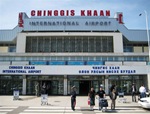
I still can't get over the fact that they renamed the airport from Buyant Ukhaa to Chinggis Khaan International Airport. I liked the old name. Many things remain the same, while many others have changed. ![]()
Photo on the right is of the playground from my childhood. The residents have boarded up the road entrances to this area, as a private company had somehow gotten a construction license to build here and planned to demolish the playground. They had put up the construction fences during the night while the residents slept. When the residents woke up in the morning and saw the fences, they immediately grouped together to bring the entire iron fence structure down and use them to block the road entrances. This area is prime real estate in the heart of the city, about 100 metres from the Russian embassy to the left, and another 100 to the north from the State Department store. The city centre is running out of space. Kids are running out of playgrounds.
Another interesting incident while on the trip, a wedding photo session on the steps of the Parliament House. While normally you are not allowed to go up those stairs, the guards let the wedding couple up for a photo session. The same guards who a few minutes earlier told us that taking photos of the Chinggis statue from too close a range (still from behind the barricade) is not allowed. I asked them if we could stand a little further back and zoom in for photos. One of the guards said "yes, I suppose so".
And this on the left is something I would recommend to everyone visiting Ulaanbaatar city. The Natural History Museum. Worth the entrance fee of MNT2,500 (I think) just for the complete Tarbosaurus fossil only. There are various other things as well, but this section of the museum has always been my favourite since childhood. The downside is, there are usually no narrators available, which is a bummer if you don't speak Mongolian. They do have English plates for most of the exhibits.
| Some other random photos at the Square, Dashchoilin Monastery and near the Turtle Rock. Blue sky and evening sunset beauty, sadly thanks to our increasing pollution in UB. | |
Monday, September 15, 2008
First Paralympic Gold for Mongolia
Baatarjav Dambadondog or Dambadondogiin Baatarjav brought home the first Paralympic Gold medal for Mongolia, in Men's Individual Recurve - Standing category (read: Archery) in Beijing on Sunday, September 14. The official Olympic site says:
The Mongolian archer began tentatively, failing to impress in the first two ends. But he showed his class in the third and fourth end, outscoring his French opponent 50-41.Three Gold medals for Mongolia this year from the ~lympics. Needless to say the Paralympics get far less media attention than the Olympics. D.Baatarjav will be awarded MNT 120 million (USD 104,000 or so) from the government, same as the medalists of the Olympics (though I heard rumours that the officials were considering of increasing the prize to USD1million for the Olympians) I wonder if many private companies are promising him sponsorhips and gifts as had happened with the Olympic medalists.
Thursday, September 11, 2008
Mandakh Naran - Mongolian Traditional Song
So this song was sampled by Deep Forest in their 1996(?) album Boheme, in a track called "Lament". It's a beautiful traditional Mongolian song. If you can get past the man moaning in constipatory desolation and wait till the Mongolian chorus kicks in, you will definitely enjoy it. It irks me that there's a man making a living moaning over perfectly good songs. What's also unfitting is that the song they sampled is hardly a lamentation, it's a love song. Apart from the name and the moaning, the song is remixed very well, I have to admit. So here goes a video a youtube user RolnThundr put together:
A Mongolian boy-band Camerton has done an acapella version of the song, which unfortunately I can't embed. Here's a link to it.
BBC Article: Why Mongolia wants more neighbours
What I like about BBC, apart from their high standards and informative articles, is that they also put a map of the region mentioned in the article. Truth be told, there aren't a whole lot of people who can point Mongolia out on a map. Or maybe that's because I am in Singapore, where world geography is not a very important subject in schools.
An article on BBC website more or less sums up the dilemma of being stuck between Russia and China neatly.
So could Mongolia's "third neighbour" policy put it on a collision course with former masters?"Former masters"? Isn't that a slavery language? I take back the whole BBC high standard thing. The question is, what percentage of our "positive link-building" is proactive and what percentage reactive? At times, I feel as though the Mongolian government is having to fend off the foreign dignitaries and new best-friends, who seem to be flocking to the youngest democracy in Asia this year. Canada is reportedly opening up its embassy in Mongolia soon. Perhaps Australia next, seeing as the foreign minister visited Mongolia this summer. And then we will see long queues for visas from 5am every morning outside the Canadian and Australian embassies in UB. I digress. Far as third neighbours go, BBC article author approves of our "realistic diplomatic expectations", which is summarized as "Mongolians are on their own when the shit hits the fan".
No, says Dr Kerry Brown of UK think-tank Chatham House. Mongolia may want to expand its ties but it knows where to stop.
"The Mongolians are being realistic with their diplomacy and building good, positive links throughout the world," he said.
Today, Mongolia knows it must maintain close bonds with its giant neighbours, both of which are vital to the land-locked nation.Read the full article on BBC website
China is Mongolia's largest trading partner, followed by Russia. Russia supplies almost all of Mongolia's oil, China controls its access to ports. Both are major investors and both have their eyes firmly fixed on Mongolia's mineral wealth.
But the young democracy - mindful of past subordination to Moscow and China's voracious appetite for natural resources - also sees diversifying its international ties as the best guarantee of its political and economic independence.
So it has been seeking to build new relationships, both with the West and with other Asian nations, in a variety of different arenas. Mongolia calls it a "third neighbour" policy.
Friday, September 5, 2008
B.Jargalsaikhan Arrested

Head of the Republican Party of Mongolia (Bugd Nairamdakh Party), B.Jargalsaikhan (more popularly known as Buyangiin Jagaa [he is the CEO of Buyan company, last I remember]) was detained for questioning on 4 September, reports Unuudur. He is reportedly a suspect in the ongoing investigation by the Prosecutor General's office into the organizers of July 1 riots. B.Jargalsaikhan was the only candidate from the Republican Party to be elected into office in the 2004 Parliamentary elections, and served as the Minister of Industry and Trade before. None of the Republican candidates won in this year's election. Along with B.Jargalsaikhan, O.Magnai and J.Batzandan are also accused of instigating or organizing the riots. O.Magnai and J.Batzandan were detained at Gants Hudag detention centre for a number of weeks until both were released on medical grounds. They are both awaiting trial under the Criminal Code.
100km Ultramarathon around Khuvsgul Lake
A Youtube user flyingman1974 uploaded the following video chronicling his Sunrise to Sunset ultramarathon around Khuvsgul Lake on July 11 this year. 100km! Around Khuvsgul! 100km! (Google tells me that would be around 62 miles which means as much to me as saying the distance is around 400 cubic gallons. I never bother to remember the conversions to imperial. Though imperial system has its funnier sides, such as telling people your height in feet.)
Thursday, September 4, 2008
Alcoholism in Mongolia
Kirril Shields wrote an interesting article in the UB Post titled "Internal or External? Alcoholism in Mongolia", on the problem of alcoholism in Mongolia. Admittedly, alcoholism is one of the bigger cultural / social obstacles to progress and development in Mongolia. And it definitely is the number one hindrance to productivity and efficiency. Excerpts:
By all accounts, according to reports, statistics, observers, officials and even tourism blogs, alcoholism, far from it being simply a difficult thing to remove, grows by the year, making the problem something of a national disaster. When the basic governance of a country or foreign investment in a nation is hindered by alcohol use, then alarm bells should ring.
"As many Mongolians," states a paper written for America’s National Intelligence Council in 2007 by Ashley Derrick, "forced to abandon their nomadic lifestyle in exchange for a cramped, urban existence, are succumbing to an epidemic of alcoholism, it is likely Mongolia will experience an increase in liver disease and other health complications resulting from alcohol abuse in the next 10-15 years." The point of his statement was to warn the American government that alcohol is one factor "significantly threatening [the] United States’ strategic interests in Mongolia’s national and regional security, democratization, and economic sustainability."
Read the full article here.
Tuesday, September 2, 2008
Maps, Politics and New "Friends of Ours"
So during my 5-day trip to Mongolia, things took place. Everywhere. Hurricane in New Orleans again, Japanese PM resigned, riots in Thailand and we finally have a new Parliament. Ts.Elbegdorj has resigned from his post as the DP chairman.
Map controversy is taking place in Mongolia due to a Chinese company posting a map of China with Mongolia included and not only that, Mongolia is listed as one of the "Other Cities" next to the "Major Cities". After complaints and emails from Mongolians and perhaps even officials (who knows), they fixed it... by changing the name to "Inner Mongolia" and shading it a slight darker yellow. Sheer incompetence / utter stupidity or political insult to a sovereign nation? (or perhaps a sneaky conspiracy of the Chinese cartographers.) Have a look here. I thought about posting the photo, but given human nature, I am afraid when the image shows up on Google Images, some may mistake it for a genuine map.
After nearly 2 months of stalemate, the new Parliament took oath on August 28 with 69 of the 76 members.
General Election Committee presented 3 additional names from the disputed Khentii Aimag constituency.
Ts.Elbegdorj, disappointed, submitted his resignation to his party in a protest over the DP's decision to take the oath before their full demands were met by the General Election Committee. Among them was to have all the names of all 76 members, including the 7 remaining electees from the disputed constituencies, presented to the President.
On the 30th, the DP committee convened to elect a new chairman. N.Altankhuyag won by 17 votes over Z.Enkhbold.