Wednesday, April 30, 2008

Haranga - Ene Bol Durlal Bish (Youtube Video)

Ok this is something of a nostalgia for me. Haranga has been around for years and it is one of the rock legends in Mongolia. Perhaps I should say that they were the first rock band in Mongolia.

Their lead singer Lhagvasuren was recently locked up for 11 years for cannabis consumption and dealing, along with a few other local pop-music celebrities.

Frankly speaking, I was never really into Lhagvasuren as a singer. The band leader and lead guitarist Enkh-Manlai has always been my personal favourite as a vocalist in the group. But that aside, I was shocked to learn a person could get shipped off to prison for 11 years for smoking grass. Even in Singapore, you'd get a year or so for smoking grass. Unless you're caught in possession of a large quantity, in which case you'll probably get hanged in Singapore.

This is a video clip of Haranga's song "Энэ бол дурлал биш", which means "This is not love". When I first heard it I was a kid and didn't really listen to the song's lyrics. The song starts out with Enkh-Manlai's awesome bluesy guitar solo.

My favourite song by Haranga by far is Enkhmanlai's song "Ayalguu". Definitely his best piece of work. I found a website you can download the song in mp3 format: Go here for the song.

Tuesday, April 29, 2008

Mongolian Food Recipes

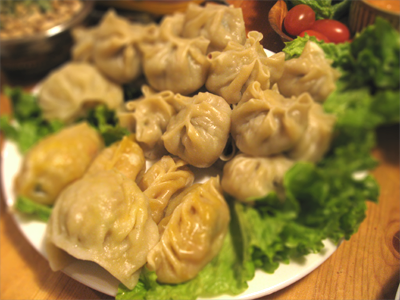
Buuz - Mongolian Steamed Meat Dumplings. Photo taken during Tsagaan Sar this year. There are a few websites with recipes on how to make Mongolian dishes: the authentic Mongolian food, not the grill-buffet fiction you get at "Mongolian" restaurants outside of Mongolia.

One has to hand it to the copywriters employed to do the marketing copy for these restaurants. Below is an excerpt from a well-known US-based "Mongolian BBQ" restaurant's website:

Centuries ago in the province of Mongolia, the Mighty Khan's hunting parties would camp on the banks of the great river Khan-Balik. After days devoted entirely to hunting, they would gather in droves to celebrate their successes. Communing in banquet style pavilions, the Mongols would prepare slivers of meat and vegetables by slicing them with their razor sharp swords. They would then cook their food by searing it on their overturned shields that were heated by a blazing fire. The Kublai Khan and his fiercest warriors would sit high above the hordes, and enjoy the same food prepared for him on a large, roaring hot griddle.

Now stop to imagine this scene: Mongol warriors, covered in battle dust and blood, slicing meat and vegetables with their bloodied swords and to add even more delicious human blood'n'sweat flavour to their meals, they proceed to cook their dinner on their overturned shields, thus rendering their shields unusable. Perhaps drinking the barbecue-juice as it drips through the arrow-holes in their shields. All of this in a "banquet-style pavilion".

What kind of disgusting, inappropriate people do they think Mongols were? On a second thought, I take my first statement back. There's nothing to hand to the copywriter of this particular blurb except a grease-covered, soot-blackened overturned shield to the face. Who in the right mind and proper taste would have an appetite for a buffet with this image in mind? And what do they mean by 'in the "province" of Mongolia'? It was the second-largest land empire in the history of the world, they call it a "province"? Not the mention the fact that "The Mighty Khan" sounds something out of the Jungle Book or a Disney cartoon.

I realize that Mongolian food itself is packed with free-range, strong and fatty meat, which most foreigners can't digest very well. Our milk gives them diarrhea, because it's simply boiled after it comes from the pasture, leaving the delicious creamy taste in. Hard to compare that to the watered down carton milk one gets in supermarkets of developed countries.

Rambled on for a bit. Go here if you want to get some recipes to Mongolian dishes

Mongolian Government Denies Shaariibuu's Statement

Further to the post regarding Altantuya's father Shaariibuu's statement that Mongolia will severe diplomatic ties with Malaysia, the Ministry of Foreign Affairs, Mongolia issued a clarification to the effect that Shaariibuu's statement is a personal opinion not the government position.

More at UBPost Blog

Monday, April 28, 2008

Shaariibuugiin Altantuya's murder: Father's Emotional Press Conference Statements

Altantuya Shaariibuu's murder case has been in the centre of media attention in Mongolia and SEAsia. Recently her father gave a press conference in KL during which he stated that the Mongolian Government will severe all diplomatic ties with Malaysia should the trial be deemed unfair. Now, I was not very sure he meant that when I read about it in the news. But having watched the press conference, I realize that it is more than just a statement.

The PM of Mongolia has written to the PM of Malaysia a number of times, and have gotten no replies. The Mongolian government mailed the letters and having received no replies, sent an emissary down to Malaysia to hand the letter to the Malaysian government officials. The last letter sent to the Malaysian PM's office from Mongolia was signed by the Minister of Foreign Affairs in Mongolia. This letter stated that the Mongolian government was prepared to severe all ties with Malaysia in the event of an unfair trial. I don't know how much weight it will bear with the Malaysians.

If you are not a Mongol-speaker and watch the below youtube video in the English translation, the weight of the father's emotional statements will not come through. In the translation, much of the anger and emotion were lost. But I suppose you will see those at the end when the father bangs the table and leaves the press conference, after admonishing the Malaysian government with "How can you do this? Where is your humanity?"

Tibet and Mongolia

H went to the anti-China rally during the olympic torch relay in Canberra. He said the Tibetans and Tibet-supporters were outnumbered by the busloads of Chinese by 20 to 1, trying to drown out the protests and the Tibetan flags with their Chinese flags.

Led me to thinking about the relationship between Mongolia and Tibet. Came across some sites before on this issue.

In 1913, Mongolia and Tibet signed a treaty declaring themselves to be independent states. The English translation of the treaty can be found here. Obviously this treaty was not considered legitimate by the rulers of China. Tibet was shortly occupied by Chinese troops, first of the genocides that would culminate in the massacre of millions of Tibetans

I also found an interesting article on the Tibet / Mongolian relationship and shared history. Below is an excerpt:

By the time Mao's successor finally granted the country the status of "Tibetan Autonomous Region" in 1965, the country had seen "1.2 million deaths, the destruction of 6352 monasteries and nunneries, the absorption of two-thirds of Tibet into China, 100,000 Tibetans in labor camps, and extensive deforestation."

And though religious freedom was reestablished, it was done so more nominally than in sincerity. In addition, monetary rewards were offered to Han Chinese willing to uproot and move to Tibet, and the year 1984 saw over 100,000 take up the offer.

Read the full text here

Friday, April 25, 2008

Mongolians in Taiwan

I came across this interesting bit of information today while idly googling for "overseas Mongolians". The first search item that caught my eyes was the "Mongolian and Tibetan Affairs Commission" website of Taiwan or ROC as they call themselves. Their website is available in Mongolian, so if you wanna have a read through their objectives, go right ahead.

Objective no.3 is this:

3/ Монгол Улсын залуучууд Тайваньд Хятадын хэл ,соёлыг судлан суралцахад зөвлөгөө өгч туслах.
Translated it says "Provide assistance and guidance to Mongolian youth on studying Chinese language and culture in Taiwan" or their official English language version says: "Encourage Mongolian youths to visit Taiwan to study Chinese culture and language".

I don't know. This whole "encourage... to study Chinese culture" thing worries me. I thought we were doing fine. Why all of a sudden, must we be encouraged to learn an alien culture and language? In Taiwan of all places, a state that has a government commission dedicated to the affairs of a sovereign nation, Mongolia.

Intrigued, I decided to find out exactly how many Mongolians there really could be in Taiwan. And found this Wikipedia article. What this article says is that there were a total of 77 Mongolian migrant workers in Taiwan by September 2004 ( I assume they were trained in "Chinese culture and language" by some guys in chipmunk suits...maybe. I like the idea though. Of chipmunk suits.)

Chipmunks aside, the goal of the project was to have over 10,000 workers from Mongolia by 2005 (source). The Taiwanese were immensely impressed with their new batch of workers from Mongolia, a country which they'd stubbornly considered to still be a part of China for many years after its declaration of independence. They were impressed, because 10 of the first 11 nurses they'd received had university degrees.

But this is the reality in Mongolia, and reality for Mongolians heading across the border for a brighter future and a thicker wallet. Most of these Mongolians are well-educated. In Singapore, I notice that many of the immigrant workers they receive from around the region are indeed workers, though there definitely are exceptions, but in most cases they are high-school graduates barely literate / conversant in English. In the case of Mongolian workers in, say, S.Korea, USA, Japan or Taiwan, they would be people with university degrees in Economic Studies, History and so on. Educated, underpaid and desperate. Leaving their academic careers in Mongolia to wash dishes, clean floors and wrestle with bricks in an alien country.

There are Taiwanese voicing out the protests over the Taiwan-Mongolia labour issue. One Taiwanese writer, a former chairman of the Mongolian Tibetan Affairs Commission opines:
The decision is merely a step toward the "de-sinicization" of Taiwan in a bid to implement the DPP's "Resolution on Taiwan's Future."
And furthermore, quips:
...Article 4 of the Constitution stipulates that "The territory of the Republic of China according to its existing national boundaries shall not be altered except by resolution of the National Assembly." But the ministry's decision undoubtedly treats Mongolia as an independent state. This is unconstitutional.
You will see the emphasized sentence. This article was published in Taipei Times on September 13, 2002. Mongolia had been independent for 81 years by 2002. Yet the writer protests that the bi-lateral agreement decision by Taiwan's Ministry of Foreign Affairs unconstitutionally recognizes Mongolia as an independent state. This sort of Sino-centric, arrogant, ignorant, imperialistic rubbish is what makes the Chinese so unpopular in Mongolia and contributes to the growing anti-China/Chinese sentiment in Mongolia.

After having questioned our legitimacy as a sovereign state, the writer further adds:
What advantages can we have by playing this card? Will Mongolia admit the ROC as a result or support Taiwan's bid to rejoin the UN? Will high-ranking Mongolian officials, who care very much about China's attitude, pay frequent visits to Taiwan? I'm afraid that the answer is "no" to all three questions.
Advantages to the Taiwanese is obvious enough: cheap imported and educated foreign labour. Will we support the ROC in their bid? In my opinion, never, not so long as a Mongolian-Tibetan Affairs Commission still exists in Taiwan and people such as the writer of this news article continue to perpetuate misinformation about Mongolia as a nation. Why should we support a Chinese state that refuses to respect Mongolia's status as an independent nation?

As far as high-ranking officials are concerned, it's probably the least of our worries. We received the Dalai Lama so many times against protests from the Chinese government. And far as Mongolians are concerned, the Taiwanese ARE Chinese, and we see no reason to meddle in the fight between 2 Chinese states.

Of course, the writer's status as a former chairman of the mis-guided Mongolian Tibetan Affairs Commission may have distorted his perspective. He does admit that the Taiwanese government's policy regarding Mongolia runs contrary to his delusional beliefs.

Awareness of Mongolia as a nation is lacking in the developed world. And more damage is done to Mongolia's status as a nation by Sino-centric articles in the Chinese and Taiwanese media perpetuating the misinformation that Mongolia should be a part of China. Mass distribution of misinformation then becomes mass miseducation regarding history and current affairs.

I have had a Chinese customs official tell me to head down to the domestic terminal for my flight to Mongolia, to which I furiously replied (in English) "Mongolia is a country, it's not in China".

If you are travelling to Mongolia, whether you're Mongolian or a foreigner, and you happen to transit at the Beijing International Airport in China, just go ahead and ask a few Chinese nationals what they think of Mongolia. Perhaps even ask an airport staff. You may be baffled at the completeness of the ignorance they display regarding Mongolia.

Thursday, April 24, 2008

Altan Urag - Mongolian Music

I don't know why I haven't posted this before. Altan Urag is a Mongolian folk rock band doing some innovative things with Mongolian music. They use traditional instruments to for a fusion rock / folk sound. I finally had a chance to buy their album when I was in Mongolia, and have been addicted to it. Their current album is called "Made in Altan Urag". I read that it's their second album, but I haven't found the first album in the cd-store. Incorporating khoomii (throat-singing), traditional instruments, Urtiin duu (traditional long-singing) and even a blues guitar on one track, their music is definitely the freshest and most innovative piece of modern music to come out of Mongolia. They also contributed a few tracks to the controversial "The Mongol" movie in 2007. Controversial in Mongolia due to the liberties it takes with Chinggis Khan's (Genghis Khan if you prefer) life, the movie nevertheless was a good international launching pad for the musicians of Altan Urag.

Watch the clip below. (A well-combined clip for Davalgaa / Ijii Mongol songs from their album "Made in Altan Urag")

Wednesday, April 23, 2008

Mongolian PM discusses food shortage with the Russians and other issues

Wonderful stuff.

Mongolia cannot expect Russian fiscal altruism to continue indefinitely. Despite the wheat subsidies, Moscow is gradually increasing prices on a number of other Russian imports. The Mongolian media has reported that the country’s civil aviation industry, like its Western counterparts, is facing disruptions due to soaring fuel costs. Mongolian airlines imports its fuel from Russia, which has drastically increased the price of its aviation fuel exports from $137 to $225 per ton over the last six months (Өдрийн Сонин, April 21).

Read more of this article from Eurasia Daily Monitor
Wheat subsidies in Mongolia. In Singapore and the rest of Southeast Asia, people are hoarding rice, anticipating rice shortage due to god-knows-what. Doesn't personally affect yours truly, as I've given up rice three months ago, and have ever since enjoyed a somewhat less bloated composition. I suppose it depends on how your metabolism is structured. Most regular rice-eaters eat 3 times more rice than I used to, and still remain stick thin.

In any case, the funny thing about the current rice shortage in Singapore supermarkets is that it is caused by people hoarding rice in anticipation of rice shortage.

I digress. What the rising fuel costs in Mongolia mean, to me, is the rising cost of flying in and out of Mongolia. It's expensive enough to fly from Beijing to Ulaanbaatar, a mere 90-min flight that could cost more than 400USD on Air China, which is why I go through the hassle of booking an Air China ticket to Beijing and buying a MIAT ticket to Ulaanbaatar. MIAT, or Mongolian Airlines, ticket costs around 260USD one-way, or 360USD, last I checked. Still a bit expensive for those used to budget airlines that charge 5USD per ticket excluding taxes. Bloody good ruse too, these budget carriers, putting up tickets from Singapore to most SE-Asian cities for 5USD a pop. You will end up paying around 200 Singapore dollars anyway, once the taxes all add up. But it works psychologically. Save a few bucks, enough to get you from the airport to your budget hotel or the hostel.

I don't know why none of the larger companies in Mongolia have come up with a budget carrier. Perhaps the Mongolian government is reluctant to give out licenses to new carriers. At the moment, there are only 3-4 carriers flying in and out of Mongolia. MIAT, Korean Air, Air China and Aeroflot. I don't know if JAL is involved with the summer flights to Osaka or if it's just MIAT flights.

Friday, April 18, 2008

Role of Buriad / Buryat Mongols in modern Mongolian history

I am half-Buriad and half-Khalkh. I have to admit though, I didn't know much about the ethnic differences between Buriads and Khalkhs except for the language and sometimes their facial features. And that comes from having a Buriad mother and a Khalkh father. Personal observations mostly. What I recently found out was that Buriads were politically very active in the early days of the Communist Revolution. To their detriment really.

There were many Buriads living in the Russian territory north of the Russo-Mongolian border. When the October revolution came, a lot of Buriads fled down to Mongolia. And Buriad intellientsia were the first group of Mongolians to start the discussion on an all-Mongol state and attempt a "sit-down" with Uvur Mongols (South Mongolians, today's Inner Mongolians) and Ar Mongols (today's Mongolia, but literally means North Mongolia). Obviously their Mongol nationalism and their rejection or rather silent refusal to accept and assimilate into the new communist regime didn't please Stalin one bit. In the late 1930's, Stalin's hatred of the Buriads reached Mongolia. Starting with the "Lhumbe affair", in which 311 people were convicted of being counter-revolutionaries and political dissidents and accused of a conspiring to overthrow the communist government with the help and under the instruction of the imperialist government of Japan. Out of these, more than 250 were influential Buriad intellectuals and politicians. Some were shot, some were sent to a gulag in Siberia and others sentenced to jail. The Stalinist purge of the 1930's targeted Buddhist lamas and Buriad ethnic groups of Mongolia. My grandfather, a Buriad, at that time was a young man, and was exiled far off for a few years. My great-grandfather, my grandmother's father, also a Buriad, was shot.

This systematic genocide of the Buriads was something I wasn't aware of. Many of the Buriads were educated bi-lingual and perhaps Mongolist intellectuals who would've been influential in the Mongolian politics, had they lived.

What followed was a Khalkh-centric national identity under communism. Ethnic minorities were alienated and spied upon.

I still have many relatives in Ulaan-Uud (Ulan-Ude on the map, name means "Red Door" in Mongolian) , Buryatia, Russia, separated from us when the Russo-Mongolian borders were drawn. My great-great-grandfather was spending the summer in what-was-to-become a Mongolian territory, while his brother was "summering" in today's Buryatia. Thus, suddenly they found themselves citizens of different countries.

Thursday, April 17, 2008

Mongolia issues stamp honoring sumo champion Asashyoro

Photo: Asa using his butler's duster as 'target practice'


Ok, I admit that I was an avid philatelist when I was in primary school. In plain english, I used to collect postage stamps. Fancy word for a mundane activity eh. But the quality of Mongolian stamps in those days was extremely good, and the artworks and topics they covered were particularly collectible.

I don't know if I would've gotten this particular set though. I am hoping that this particular photo on the left isn't going to be used in the stamp set.

Tuesday, April 15, 2008

Live History - Photos of Mongolia


Live History
Originally uploaded by zazaa.
This striking portrait and more amazing photos of Mongolia at Flickr user Zazaa's page.

Monday, April 14, 2008

Mongolia to decide on Rio Tinto's Oyu Tolgoi gold, copper project before June

This is the topic that has had many investors following the news worriedly. What will the former commies do in terms of taxation on the mining sector? The Parliament is expected to pass the regulation within weeks, before the June parliamentary elections. What they decide will shape the future for Rio Tinto's $3 billion Oyu Tolgoi project.

A key change in the proposed amendment is a plan to give the government an option to seek a higher, 51% share in strategic projects, as opposed to 34% now, said Bold Luvsanvandan, chairman of the Mineral Resources and Petroleum Authority of Mongolia.
Strategic projects are defined as those with revenue exceeding 5% of Mongolia's gross domestic product, which currently is around $3 billion. >>Read full article
So the Oyu Tolgoi can and should be classified as a stategic project. In December 2007, the PM Bayar announced that the government will take control of the privately-held Tavan Tolgoi coal mine project, worth an estimated $2 billion. While this sudden wave of nationalistic and protective measures by the Mongolian government may dampen the investors' interest in Mongolia, it is probably a necessary move. Time to pull the brakes on the "gold rush" craze. So long as the natural resources are there, there will always be buyers and investors. Plunder it all and we'll be left with craters the size of mountains, with our rivers polluted with cyanide and mercurial water.

Add to any service

China Has Ignored Repeated Mongolian Attempts to Claim its Citizen Unlawfully Arrested in China

A Mongolian citizen, a vocal opponent of the Chinese government's policies regarding Inner Mongolia, has been detained in China. Is this indicative of the direction in which China-Mongolian relationship is heading? Mongolia's diplomatic relationship with China has always been restrained at the best of times, while the Mongolian public opinion and sentiment towards the Chinese government and at times the Chinese people have been that of distrust and often-times, open hostility.


Jaranbayariin Soyolt is a citizen of Mongolia who was unlawfully arrested when he arrived in Beijing on a business trip in January. His companions on the trip witnessed his arrest and states that the Chinese police attempted to disguise the handcuff with clothing garments. Mr. Soyolt is one of the few brave people who are outspokenly opposing the Chinese occupation and gross abuse of human rights in South (a.k.a. Inner in sino-centric terminology) Mongolia. He is originally from Ordos in Shiliin Gol aimag and he has been an active member of the opposition efforts outside of the region that was occupied by the current Chinese regime 60 years ago.
The Ministry of Foreign Affairs and the Mongolian Embassy in Beijing have tried repeatedly to ask China to extradite the citizen, who is protected by the Mongolian government by law. China has ignored the government of Mongolia, raising questions about the respect China has for our government.

More here (English) and here (Mongolian).

Wednesday, April 2, 2008

Victims of Human Trafficking

Human trafficking is one of the major social problems in Mongolia. Most of the trafficking operations are set up as marriage service companies, sort of a "mail-order-bride" business, offering to set Mongolian girls up with affluent and educated foreigners from S.Korea, Hong Kong, Macau etc. Most of the girls who fall for this end up in forced prostitution and sexual slavery in a foreign land with noone to turn to.

Eagle TV journalist Bathishig has done an important piece on this issue and has received death threats from operators of these services. She cites a tragic example of a Mongolian girl ending up in forced prostitution in Macau, who has recently passed away due to cervical cancer caused by the injections administered by her captors intended to stop her menstrual cycle so she could "work" everyday of the month. Click below to watch the full report (for more information visit Tom Terry's blog)